

Leaks in industrial gas systems can range from almost unnoticeable to disruptive and dangerous disturbances. Locating a leak in compressed air, gas, and vacuum systems can be challenging and time-consuming but quite necessary if the leak is to be repaired. Several gas detectors are available, using stationery and mobile or hand-held equipment to search for escaping emissions. In extreme cases, leaking gases may be toxic, with pressurized gases that include ammonia, chlorine, nitrogen oxide, and sulfur oxide that must be detected and monitored. In less severe cases, escaping gases such as oxygen (O2) may be safe to an operating environment, but a leak or leaks represent an ongoing expense in the loss of a resource.
Gas leaks can be found in numerous ways, often by pressure testing a gas storage unit or interconnecting hose to enable gas sensors to measure beyond their minimum detection limits. Numerous types of gas detectors, such as electrochemical sensors, infrared (IR) sensors, semiconductor sensors, and ultrasonic sensors, provide differing gas detection sensitivities depending upon sensor operating environments and temperatures and must be optimally matched to a specific gas detection application. As an example, through a chemical reaction with a gas of interest at a sensing electrode, an electrochemical sensor generates an electrical signal proportional to the amount of gas present. To achieve high accuracy, the sensor relies on an additional reference electrode to stabilize the electrolytic process.
For hazardous gas leaks, industrial gas detection can help preserve workers’ safety. If performed efficiently, it can also ensure the efficiency of a warehouse or production facility by eliminating downtime due to gas leaks. By practicing gas detection as part of a preventative maintenance program, production time can be saved and unwanted facility downtime avoided.
Give It the Gas
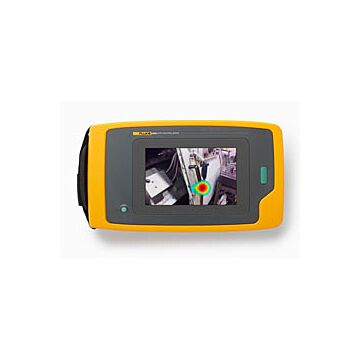
Transcat | Axiom Rentals offers a wide range of gas leak detectors based on some of the latest and most effective gas detection technologies. As an example, the Fluke ii900 Sonic Industrial Imager is an easy-to-use and compact measurement tool for locating leaks in compressed air, gas, and vacuum systems using the sound produced by the flow of the gas to locate the leak. It employs an array of microphones to measure the levels and time delays of the sound waves from the source and calculate the location of the leak producing the sound. The 64 microphones are based on microelectromechanical-systems (MEMS) technology for extreme miniaturization and high measurement precision. The MEMS microphones provide 63 ± 5 deg. field of view (FOV) for sound waves from gas leaks.
The compact instrument uses SoundSight™ technology to create visual representations of the audio captured by the microphones. By applying transformational software, the ii900 creates a SoundMap™ color image of an operating environment so that a gas leak can be identified and isolated even across a large detection distance. It shows visualized gas leaks on a 7-in., capacitive touchscreen liquid-crystal display (LCD) with 1280 × 800 pixel resolution. The ii900 operates over a wide range of 2 to 52 kHz and can detect gas leaks as far as 164 ft. (50 m) away. The imager has an operating temperature range of +32 to +95°F (0 to +35°C) and runs for 6 h on a rechargeable (3-h charge time) lithium-ion battery. The instrument measures 186 × 322 × 68 mm and weighs just 1.7 kg with the rechargeable Li-ion battery installed.
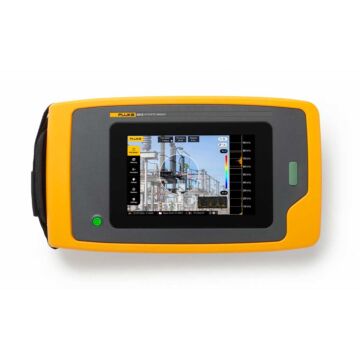
With an even wider frequency range--2 to 100 kHz--the Fluke ii915 Acoustic Imager can record fundamental and harmonic tones from leaking gas. It can also detect electrical arcs and partial discharges, for example, from faulty insulation in electrical connections, which can lead to flash fires. It has an impressive detection range of 1.6 to 393 ft. (0.5 to 120 m), revealing results on a 7-in. LCD with 1280 × 800 pixel resolution. The ii915’s 64 MEMS microphones provide a nominal FOV of 63 ± 5 deg. for wide-angle detection of gas leaks. The ii915 Acoustic Imager shows sounds via the SoundMap™ imaging software, at a frame rate of 25 frames/s. It features 32 GB built-in memory—enough to store about 8,000 pictures or 1,600 videos. The ii915 can capture and save about five minutes of continuous video.
The ii915 includes a pair of USB-C ports for battery charging and data transfers and Wi-Fi for wireless monitoring and control. It runs for about 6 h on a Li-ion battery with recharge time of 4 h. With its unique LeakQ™ software, the imager can scale the size of a leak and leak rate during measurements for making cost and repair estimates. The instrument meets U. S. Federal Communications Commission (FCC) requirements for 47 CFR 15 subpart C, IEC 61010-1 general safety standard requirements, and IEC 61326-1 industrial EM compatibility requirements. It has an operating temperature range of +14 to +113°F (-10 to +45°C), measures 7.3 × 12.7 × 2.7 in. (186 × 322 × 68 mm), and weighs 4.4 lbs. (2.0 kg).
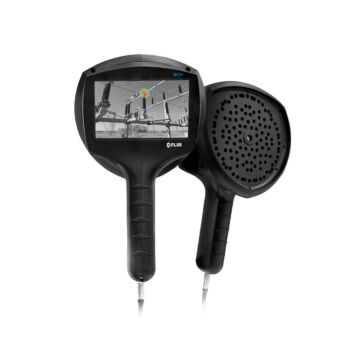
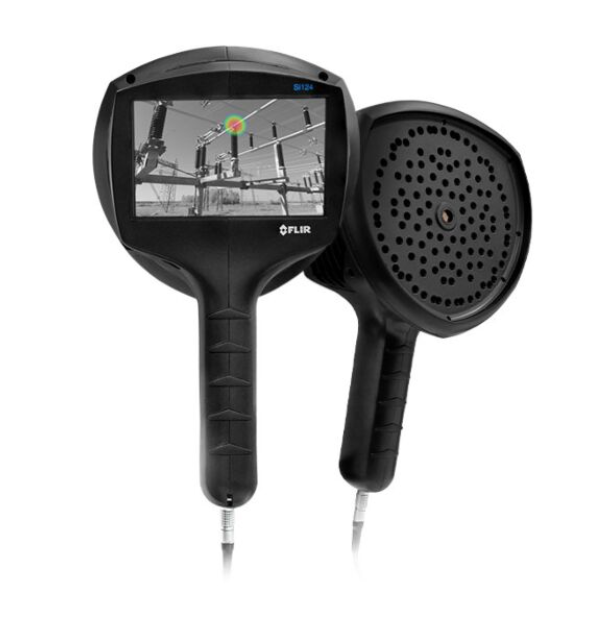
The FLIR Si124™ is an Industrial Acoustic Imaging Camera that eases maintenance of pressurized gas systems. It also transforms the sounds of gas leaks into video images, using 124 MEMS microphones to capture audio from 2 to 31 kHz. Images of acoustic events are transposed on top of a digital camera, making it possible to quickly pinpoint the source of the leaks making the sounds. The camera is supported by the FLIR Acoustic Camera Viewer cloud service so that captured images of acoustic sources such as gas leaks are automatically saved to the cloud for analysis.
The Si124 shows images at a frame rate of 30 frames/s on a 5-in. touchscreen with 800 x 480 pixel resolution. In addition to cloud memory, it can store 32 GB on an SD card. The acoustic imager measures 10.7 × 6.7 × 4.9 in. (273 × 170 × 125 mm) and weighs 6.4 lbs. (2.9 kg) with its rechargeable battery in place. It can be used across operating temperatures from +14 to +122°F (-10 to +50°C).
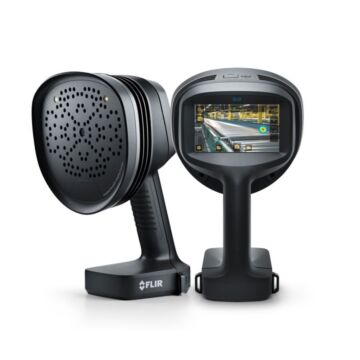
The FLIR Si2-PRO Industrial Acoustic Imaging Camera is another compact, easy-to-use instrument well suited for routine inspections and preventative maintenance. It is an invaluable tool for performing pressurized gas and compressed air leak detection, compact and portable, running for about 2.5 hours on a rechargeable Li-ion battery pack with a recharge time of only 2 hours. The FLIR Si2-PRO captures sounds using 124 MEMS microphones over a total bandwidth of 2 to 130 kHz and at detection distances from 0.3 to 200.0 m. It enables many industrial facilities to run more efficiently and save money on utility expenses.
In addition to the capability to pinpoint gas leaks with directional resolution as fine as 0.125 deg., the FLIR Si2-PRO includes a mechanical fault mode useful for detecting faulty bearings by their sound signatures. It shows images on a 5-in. display with 1280 x 720 pixel display and features automated functions to quantify leak rate and cost of industrial gas and compressed air leaks, to prioritize repair and calculate savings.
Additional information on these imaging instruments and other gas detectors can be found on the Transcat | Axiom Rentals website (www.transcat.com) or by contacting an advisor at 800-264-4059.