

Noise can be disruptive, preventing a message from being heard. For effective use of wired and wireless communications systems, such as cellular “smart phones” and satellite communications (satcom) systems, noise should be minimized if possible. But first it must be detected and identified so that it can be treated, which requires test-and-measurement equipment for that purpose. Noise measurement equipment comes in a variety of forms, as many as the types of noise that plague modern communications systems.
Noise can originate from within or outside a system or component under test. Noise from a source outside the system can radiate through the air to a communications system and start within a noisy component, such as a switching power supply, a solar inverter, or the driver for a light-emitting diode (LED). Noise that is radiated travels through the air from a source to a receiver and is typically frequency dependent and diminishing in level with distance from the source. Noise can also invade a system from a ground loop within a system or shared by multiple devices. Noisy ground loops can be caused by differences in ground potential between connected devices or differences in ground potential within multiple ground points of the same system. Noise can originate within a system because of imperfections in a timing device, such as a clock or reference oscillator. A reference clock oscillator with high phase noise can impact a radio system by causing frequency instability and shifting of tuned frequency channels during operation. It can lead to the radio system itself becoming a source of noise as it suffers spread-spectrum effects and exceeds the frequency bandwidth for which it was designed.
Radiated noise is traditionally measured with a directional antenna connected to a spectrum analyzer capable of tuning across the anticipated frequency range of noise signals. A sufficiently wide frequency band of interest is required since noise often includes fundamental-frequency tones as well as many orders of harmonic signals. The phase noise of an oscillator, frequency synthesizer, or other signal source within a communications, radar, or other electronic system can be checked with a spectrum analyzer but is typically characterized by means of a more specialized test instrument. A phase-noise analyzer, for example, can quickly filter specific analysis bandwidths at a variety of offset frequencies from the carrier frequency of a source under test for comparison to design specifications.
Knowing Noise
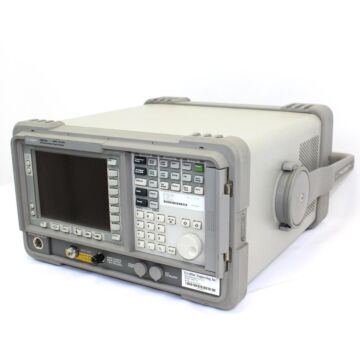
Active components capable of generating or boosting the level of a signal within a system, such as an amplifier, will contribute some level of noise with their gain, typically characterized by the component’s noise figure (NF). Ideally, an active component exhibits the lowest possible NF across its bandwidth, which can be determined by a sensitive, broadband test instrument such as the Keysight N8975A Noise Figure Analyzer. The analyzer features an extremely wide measurement range of 10 MHz to 26.5 GHz. It allows a user to measure the amount of noise within a selected bandwidth that is tuned across the instrument’s full frequency range, with measurement bandwidths that include 100 kHz, 200 kHz, 400 kHz, 1 MHz, 2 MHz, and 4 MHz.
For any noise analyzer to be effective, its own noise characteristics must be well understood and included as part of any NF measurement. The temperature of the test area and the aging rate of the analyzer’s own internal clock oscillator must be taken into consideration as part of any noise measurements. Noise figure analyzers such as the N8975A work with external noise sources with well-defined noise characteristics which they measure as part of the test setup. Often based on noise diodes, noise sources exhibit unpowered (thermal) and powered noise levels which help determine a noise source’s excess noise ratio (ENR) or difference between its powered and unpowered noise levels.
The N8975A provides high measurement precision across wide frequency and NF ranges. It has measurement uncertainty of ±0.15 dB or less when measuring noise figures of 0 to 20 dB and uncertainty of no worse than ±0.20 dB when measuring the highest NFs (greater than 20 dB). The analyzer has an internal reference oscillator with aging rate of ±2 ppm/year or better. For users in need of checking on gain, the analyzer offers a gain measurement range of -20 to +40 dB with measurement uncertainly no worse than ±0.17 dB. To ensure high accuracy, the instrument’s own noise figure is well characterized and accounted for over tightly controlled test/calibration conditions and temperatures (+23 ± 3°C). For ease of on-site testing, the N8975A shows test results on a 17-cm color liquid-crystal-display (LCD) panel.
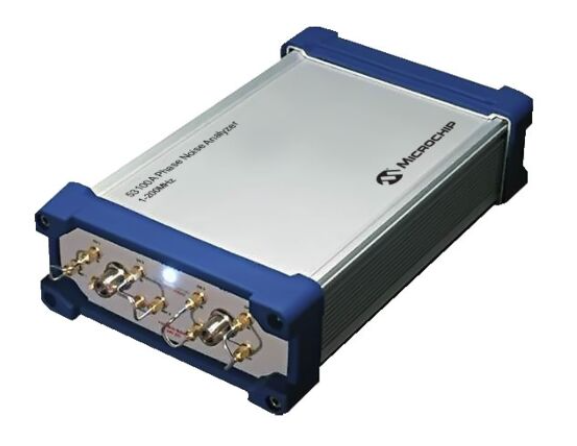
When phase noise is a greater concern, and at much lower frequencies, the Microsemi 53100A Phase Noise Analyzer checks SSB phase noise at carrier frequencies from 1 to 200 MHz. Operating by means of test software on a Microsoft Windows® personal computer (PC), the compact modular 53100A can measure phase noise and stability of a DUT over time, from fractions of seconds to days. It can also evaluate Allan deviation, frequency differences, even amplitude modulation (AM) noise. With input ports for test signals and two reference sources, reference frequencies can be selected independent of a DUT’s signal frequencies, from 1 to 200 MHz. With two references, the 531000A can perform cross-correlation phase-noise measurements at low noise levels with high accuracy.
The 53100A provides accurate phase-noise measurements without needing calibration or phase locking a DUT. It employs an intuitive graphical user interface (GUI) to simplify measurements and can measure phase noise and AM noise at offset frequencies from 0.001 Hz to 1 MHz and noise levels as low as -175 dBc/Hz at the noise floor. For a 5-MHz carrier, the SSB phase noise is typically -135 dBc/Hz offset 1 Hz from the carrier, -155 dBc/Hz offset 100 Hz from the carrier, and -170 dBc/Hz offset 100 kHz from the carrier. For a 100-MHz carrier, the SSB phase noise is typically -120 dBc/Hz offset 1 Hz from the carrier, -145 dBc/Hz offset 100 Hz from the carrier, and -170 dBc/Hz offset 100 kHz from the carrier. The modular tester, with spurious levels of typically -100 dBc, measures just 13.5 × 8.5 × 3.6 in. (344 × 215 × 91 mm).
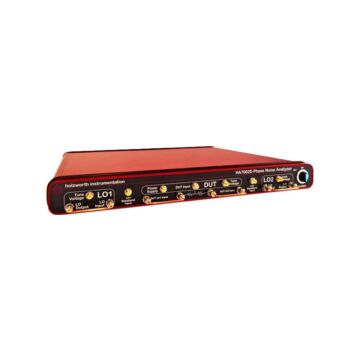
For phase-noise measurements over a wider carrier frequency range, the Holzworth Instrumentation HA7062D Phase Noise Analyzer provides real-time cross-correlation SSB phase noise measurements at carrier frequencies from 10 MHz to 26 GHz. Measurement time is a function of the number of cross-correlation test samples and the offset frequency. For example, at 1 Hz from the carrier, phase-noise measurements with 256 samples require 18 s while measurements with 512 and 1024 samples require 33 and 61 s, respectively. At 10 Hz from the carrier, measurements with 256 samples require 8 s while measurements with 512 and 1024 samples require 13 and 22 s, respectively. Finally, at an offset frequency of 100 kHz, phase-noise measurements take 4 s for 256 samples, 5 s for 512 samples, and 6 s for 1024 samples.
Supplied in a fully shielded 1U-high chassis, the HA7062D minimizes measurement uncertainty with its cross-correlation measurement approach, with phase-noise measurement uncertainty of ±4 dB at offset frequencies from 1 Hz to 1 kHz and just ±2 dB at offset frequencies from 1 kHz to 100 MHz.
Additional information on these and other noise-measurement tools can be found on the Transcat | Axiom Rentals website (www.transcat.com) or by contacting an advisor at 800-264-4059.